Baseball is practically built for wordplay: runners steal, pitchers deal, hitters drive things home, and one swing can rewrite the whole inning. These baseball puns and baseball jokes mix sharp one-liners, clean kids’ laughs, riddles, dad jokes, knock-knocks, and photo-ready captions.
Editor’s Picks: Best Baseball Puns and Jokes
| No. | Use Case | Best Line | Best For |
|---|
| 1. | Cleanup hitter pun | Our cleanup hitter takes the job literally—he brings a broom to batting practice. | Team banter |
| 2. | Pinch hitter joke | Our pinch hitter is terrible at invitations—he only shows up when called on. | Players |
| 3. | Scorebook joke | The scorebook never argues; it keeps receipts. | Baseball fans |
| 4. | Balk one-liner | A balk is baseball’s way of saying, “Actually, never mind.” | Rule-savvy fans |
| 5. | Catcher joke | The catcher bought a screen protector; foul tips were getting personal. | Dugout humor |
| 6. | Leadoff hitter pun | Our leadoff hitter hates waiting rooms. | Quick laugh |
| 7. | Warning-track joke | The warning track is the outfield’s polite way of saying, “That’s far enough.” | Field humor |
| 8. | Infield-fly joke | The infield fly rule is baseball’s way of making a pop-up come with paperwork. | Rule humor |
| 9. | Bullpen joke | The bullpen phone has one ringtone: pressure. | Late-inning humor |
| 10. | Checked-swing joke | A checked swing is a batter changing his mind in public. | One-liner |
| 11. | Doubleheader pun | Doubleheaders are baseball’s buy-one-get-one deal. | Game-day fans |
| 12. | Rally-cap joke | A rally cap is optimism you can wear backward. | Comeback games |
Short Baseball Puns and One-Liners

Batting, Hitting and Home-Run Wordplay
- Batting practice: where optimism gets several swings.
- A good hitter knows when to make contact—and when to take the hint.
- One at-bat at a time keeps the scoreboard drama manageable.
- Sluggers prefer long stories with fence-clearing endings.
- On deck is baseball’s version of a loading screen.
- Solid contact is the batter’s favorite form of networking.
- Swing big enough and even a bad pitch gets nervous.
- The bat and ball finally agreed to meet in the middle.
- Bases loaded turns every swing into a group project.
- Step up to the plate; the plate has been waiting all inning.
- The cleanup hitter treats loaded bases like an invitation.
- Walk-off wins are baseball’s mic-drop moments.
- A grand slam is four runs packed into one sentence.
- Scoring position is where even a bloop hit gets promoted.
- Designated hitters appreciate jobs with no field trips.
- Extra-base hits are singles with ambition.
- The sweet spot is where bats go to feel understood.
- A frozen rope is the only rope a batter wants to create.
- Line drives don’t waste time taking the scenic route.
- Batting order is just a very competitive waiting list.
- Great timing turns a fastball into a souvenir.
- Taking a walk is the batter’s most productive stroll.
- Contact made; ghosting officially over.
- Fence-sitters make terrible power hitters.
- Keep your eye on the ball—apparently it dislikes supervision.
- That homer gave the baseball a very short return policy.
- Excuses got benched before the first pitch.
- Bunting is what happens when a hitter whispers instead of shouts.
- A hit-and-run is multitasking with cleats.
- Follow-through: because stopping halfway is bad for swings and stories.
- Sluggers keep their résumés full of major hits.
- “Hit it out of the park” sounds less metaphorical from the batter’s box.
- Bat flips are exclamation points made of maple.
- Two outs, bases loaded: baseball’s favorite pressure cooker.
- A pinch hitter is the lineup’s emergency contact.
- Home plate sees more traffic than a downtown intersection.
- Good hitters place the ball where defenders forgot to RSVP.
- Line drives skip the sightseeing and head straight for trouble.
- Clutch hitters treat pressure like batting practice.
- Two strikes turn the batter’s box into a very small decision room.
Pitching, Strikes and Curveball Wordplay
- Curveballs are proof that straight answers are overrated.
- Pitchers deliver; hitters decide whether to return to sender.
- A changeup is speed wearing a disguise.
- The bullpen is baseball’s emergency department.
- Closers specialize in ending conversations after nine.
- Fastballs believe every meeting should be brief.
- Spin rate is a pitcher’s preferred kind of gossip.
- Full count: three balls, two strikes, zero room for small talk.
- Pitchers treat the edge of the plate like prime real estate.
- A high heater is a fastball with upstairs ambitions.
- Starters get first word; closers hope to get the last.
- Relief pitchers are proof that asking for help is part of the game plan.
- Command is what separates pitching from enthusiastic throwing.
- Working from the stretch is easier than explaining why runners keep getting on.
- Curveballs bend the rules without breaking them.
- Middle relief: because sometimes the plot needs a new character.
- The mound is one hill pitchers happily choose to stand on.
- Nasty movement is a compliment only pitchers truly appreciate.
- A calm pitcher can make a 3–2 count look almost reasonable.
- Backing the team is easy; backing up home takes footwork.
- Bullpen sessions are where backup plans learn to throw strikes.
- Sliders make late turns without using a signal.
- A change of pace can make a 95-mph fastball feel like yesterday’s news.
- Pitch count is baseball’s way of putting a battery meter on an arm.
- Changeups arrive late and still manage to be exactly on time.
- Ninth inning: where closers turn “almost done” into a job description.
- Windups are the only dramatic pauses pitchers get encouraged to use.
- Fastballs make their point before the batter finishes thinking.
- The pitcher lost command, so the catcher took control of the meeting.
- Location beats velocity when the fastball knows the address.
- The mound called—apparently it needs another strike.
- A good reliever can cool a rally without touching the thermostat.
- Breaking balls refuse to follow a straight career path.
- Strikeouts look unusually efficient in the scorebook: one letter, K.
- Wild pitches are throws that rejected the itinerary.
- Good pitchers paint the corners without carrying a brush.
- The bullpen has more saves than most computer desktops.
- Pitch sequencing is chess with a catcher’s mitt.
- Extra innings are what happen when nine chapters need an epilogue.
Bases, Fielding, Gloves and the Diamond
- Pickoff attempts are baseball’s way of checking whether you’re still paying attention.
- Gloves have one job: make hard things look catchable.
- Home plate is the only home everyone tries to leave and return to.
- Tagging up is patience with cleats on.
- Shortstops live where ground balls go looking for trouble.
- Cutoff men are baseball’s human forwarding address.
- A glove pocket is the safest place for a line drive to disappear.
- Rounding third is baseball’s version of seeing the finish line.
- Left field gets blamed for ideas it never approved.
- Ground balls keep infielders humble and uniforms dirty.
- Double plays are how one ground ball earns overachiever status.
- Stealing second is the rare theft that gets applause from thousands.
- Relay throws are what happen when the outfield sends the ball with a connecting flight.
- Base paths are ninety-foot deadlines repeated four times.
- Tag plays are arguments settled by fingertips.
- Slides are what happen when running out of room becomes a strategy.
- Outfielders spend a lot of time chasing long-distance relationships.
- Grounders never aim high, but they still cause problems.
- A clean scoop is baseball’s quickest way to tidy up a bad hop.
- Base stealers make “take what you can get” sound athletic.
- The infield shift is baseball furniture rearrangement with a scouting report.
- Cleats are formal shoes for dirt.
- Base coaches give directions while staying exactly where they are.
- Warning-track power is baseball’s cruelest almost.
- Foul lines are experts at setting boundaries.
- A rundown is tag with a rapidly shrinking playing field.
- The diamond is one place where cutting corners gets noticed.
- A mitt is a high-five with a pocket.
- Force plays skip the personal touch.
- Outfield grass gets plenty of cuts, just not the haircut kind.
- A headfirst slide is commitment with laundry consequences.
- Dugout shelves turn helmet ownership into a guessing game.
- Tie games are baseball refusing to choose sides.
- Safe at home is the ending every runner wants.
- Loaded bases turn a quiet inning into a traffic jam.
- Infield dirt remembers every slide.
- The final out is baseball’s period at the end of the sentence.
- Sacrifice flies are generosity with launch angle.
- Diamond life: cleats, cutoff throws, and pine tar on everything.
Choose a Baseball Wordplay Angle
| Baseball Term | Fresh Wordplay Direction | Best Use |
|---|
| Balk | False starts and interrupted motion | Rule-based one-liners |
| Pickoff | Wandering too far or getting caught off guard | Player banter |
| Tag up | Waiting for the right moment | Clever captions |
| Sacrifice bunt | Trading the spotlight for a teammate’s progress | Team jokes |
| Checked swing | Second thoughts and stopping yourself | Short jokes |
| Doubleheader | Back-to-back plans and marathon game days | Game-day captions |
| Warning track | Almost-there moments and last-second alerts | Outfield jokes |
| Scorebook | Paper trails and official records | Fan and coach humor |
Funny Baseball Q&A Jokes

Baseball Dad Jokes: Players and Positions
- Why did the leadoff hitter become a movie critic? He always gets the first look.
- What’s a pinch hitter’s least favorite phrase? “No substitutions.”
- What does a catcher call a busy workday? Back-to-back meetings at the plate.
- Why is first base so welcoming? Everybody who reaches it is told they’re safe.
- Why do outfielders shout “Mine!” so loudly? Group chats are too slow for fly balls.
- What does a designated hitter call a glove? Optional equipment.
- Why did the pinch runner like temp work? Short assignments suited him.
- Why did the second baseman enjoy middle management? The position felt familiar.
- What’s the third baseman’s favorite weather report? Hot at the corner.
- Coach: “Can you handle this pitch?” Catcher: “That’s literally why I’m dressed like this.”
- Who covers the most ground without owning any real estate? The center fielder.
- Which batter hates missing a cue? The one pacing the on-deck circle.
- What does a utility player call one fixed position? A vacation.
- Why did the base runner carry a stopwatch? He was always trying to beat the throw.
- Why did the left fielder wear sunglasses? Afternoon games kept putting the sun in his office.
- Why did the right fielder shift a few steps over? The spray chart had already spilled the secret.
- Why did the catcher ace the memory test? He had spent nine innings memorizing signs.
- Batter: “My timing feels off.” Coach: “Then stop swinging at yesterday’s pitch.”
- Why does the shortstop prefer quick meetings? Ground balls don’t wait for long explanations.
- What does a first baseman say to a runner? “Nice stop—don’t get too comfortable.”
- What ruins a pinch runner’s perfect entrance? Getting picked off before the first full stride.
- What does a slugger order with coffee? Something strong enough to clear the fence.
- What does an outfielder call a sinking liner? A reason to meet the grass early.
- What does a catcher call a pitch in the dirt? A blocking assignment.
- Which infielder hates typos most? The one charged with an error.
- How does a batter win a debate? By making a strong point of contact.
- Runner: “Should I slide?” Coach: “Only if standing up has become optional.”
- Why did the center fielder become a mediator? He was always between left and right.
- Why does the backup catcher stay loose? The next foul tip might come with a promotion.
- What does a third baseman call a hard bunt? A surprise package.
- Why did the second baseman enjoy dance class? Turning two came naturally.
- What off-field job suits a power hitter? Anything that involves driving results home.
- Catcher: “Did you hear that call?” Umpire: “So did the parking lot.”
- Why do outfielders never complain about leg day? Their office keeps moving farther away.
- What trick does a fast runner perform best? Making second base disappear behind him.
- Why did the utility player color-code his gloves? Tuesday’s infield mitt kept showing up in the outfield.
- Why did the batter bring a spare bat? Broken handles make terrible backup plans.
- Why did the switch-hitter practice in front of a mirror? Both sides wanted equal time.
- Why does a batter avoid dinner plans during a long at-bat? The count keeps changing.
- What do teammates call a rookie with a great first game? Beginner’s luck with a batting average.
Ballpark and Game-Day Jokes
- Why did the batter’s eye get promoted? It never lost sight of the job.
- Why is the foul pole good at making decisions? It knows fair from foul.
- What does the tarp call a sudden rainstorm? Showtime.
- Why was the ticket so confident at the gate? It already had admission.
- What advice does the base path give runners? “Stay in your lane—then turn left.”
- Why do stadium lights love night baseball? They finally get to play a visible role.
- What’s the dugout’s favorite kind of plan? One that’s ready off the bench.
- What does the on-deck circle hate? Being mistaken for a parking spot.
- What instrument never misses the seventh-inning stretch? The ballpark organ.
- Why did the rosin bag lose at hide-and-seek? White powder on dark dirt gave it away.
- Why does the concession stand understand lineups? It has one all game long.
- What is a rain delay? The weather calling time-out without asking the umpire.
- Why are chalk lines bad at improvising? They prefer everything straight.
- Why did the grounds crew keep a spare base nearby? Slides have a habit of rearranging the furniture.
- Why do bleachers know all the ballpark gossip? They hear everything from the stands.
- What did home plate say at dinner? “Nice to be served for once.”
- Why did the turnstile make a good accountant? It counted every fan coming through.
- Why does the seventh inning love sing-alongs? The whole stadium suddenly knows the same song.
- Why does the press box never run out of stories? The game keeps sending updates.
- Grounds crew member: “Field ready?” Coworker: “We’ve dragged this conversation long enough.”
- Why do foul balls like crowded sections? Better souvenir odds.
- Why did the runner return to third after celebrating? The defense filed an appeal.
- Why is the batter’s box easy to organize? The boundaries are already drawn.
- Why does the ballpark clock hate ties? They ruin its quitting time.
- Why does the retractable roof hate guessing games? It waits for clear skies or clear instructions.
- What did the base bag say after another headfirst slide? “Personal space, please.”
- Why is the outfield wall bad at holding onto baseballs? Hard hits keep bouncing back.
- Why did the foul line avoid the rain? It hated getting washed out.
- What does a foul ball call a seat in the first row? A target.
- What does the ticket scanner call a rejected barcode? An out at the gate.
- What does the PA announcer call the batting order? Tonight’s playlist.
- Why does the pitcher’s mound get first say in every at-bat? That’s where the conversation starts.
- What’s the dugout bench’s busiest inning? The one when everybody suddenly has advice.
- Why does the bullpen gate make relievers nervous? Opening it usually means the call is real.
- What does infield dirt do before first pitch? Gets dragged into shape.
- Why do stadium seats never take offense? They’re used to fans sitting on their opinions.
- What does the scoreboard call a lead change? Editing the headline.
- Why does the ballpark stay awake after nine? Extra innings refuse to go home.
- What does a doubleheader do to your afternoon? Turns one ticket into a long-term commitment.
- Why do fans love a walk-off? Nobody has to ask when it’s time to leave.
Teams, Coaches, Fans and Umpires
- Why did the first-base coach carry a measuring tape? Every lead looked longer from the dugout.
- Why did the umpire take a photography class? He wanted a better frame of reference on close plays.
- How do fans charge a quiet inning? Add noise until the dugout notices.
- Why is the scorekeeper good with budgets? Every run has to be accounted for.
- Why did the scout bring binoculars to the farm? He was looking for prospects, not crops.
- Why does the mascot love rain delays? Finally, the crowd has time for extra dancing.
- Coach: “What’s our plan?” Player: “Preferably one with fewer runners stranded.”
- What color makes an umpire nervous? Gray—close plays have enough gray area already.
- How do fans survive a wild ninth inning? By pretending their heart rate is normal.
- What does a manager do when the lineup goes stale? Makes a substitution.
- Why does the scorekeeper sit still all game? The players do enough running for everyone.
- Why did the third-base coach buy a windmill? He was tired of doing all the arm work himself.
- How does an umpire handle a bang-bang play? Makes one call and prepares for twelve opinions.
- Why did the team photographer love walk-offs? Nobody asks for a second take.
- How do fans create their own weather? Start the wave.
- Why does a manager love a good bullpen? Options look better when they can throw strikes.
- What does a mascot use as an alarm clock? The first cheer of the inning.
- Why does a coach change the lineup? Because “same plan, different result” gets old.
- What does an umpire do when dirt covers home plate? Brushes up before the next pitch.
- Why does the team bus understand offense? It knows how to drive.
- Why does the bench coach rarely miss a sign? He spends the game reading between the lines.
- Why did the fans form a choir? One chant wasn’t loud enough.
- What keeps an equipment manager awake? A missing glove with no name in it.
- Why does a scout carry a notebook? Memory has no box score.
- Why did the coach check the clock before calling a pinch hitter? The matchup had a short shelf life.
- What happens when an umpire hesitates on a close play? Twenty thousand fans make the decision for him.
- What does a team captain do after an error? Makes sure the next play arrives quickly.
- What do October fans call a tied ninth inning? A reason to cancel the rest of the evening.
- What key does a manager need late in the game? The one that unlocks the right matchup.
- Why does the mascot love home runs? Nobody questions the dancing.
- What does a scorekeeper erase most carefully? Anything that would rewrite the inning incorrectly.
- Why do Little League coaches carry patience? It doesn’t fit in the equipment bag, but they need plenty.
- What does an umpire lose first after a controversial call? Quiet.
- Why do fans stand for a two-strike pitch? Sitting suddenly feels too optimistic.
- What shape does a coach draw for the field? A diamond—baseball refuses to think inside the box.
- Why did the manager carry a hook? He was tired of asking pitchers to leave politely.
- Why did the scout trust the radar gun? It never rounded 97 up to “pretty fast.”
- What does a power-packed lineup call a quiet inning? False advertising.
- Why does the umpire stand behind the catcher? Best seat in the house, worst comment section.
- What does a crowd do after a walk-off? Turns every seat into standing room.
Baseball Riddles With Answers

Field and Equipment Riddles
- Four points shape me, runners circle me, and nobody buys jewelry here. What am I?
Answer: The baseball diamond. - Red stitches hold me together, but I’ve never visited a doctor. What am I?
Answer: A baseball. - Mask on, mitt ready, I work behind the hitter and receive nearly every pitch. Who am I?
Answer: The catcher. - I light up runs, hits and errors while never taking an at-bat. What am I?
Answer: The scoreboard. - One place has a mound, a plate and no restaurant. What is it?
Answer: A baseball field. - Players steal me legally and celebrate getting away with it. What am I?
Answer: A base. - I bite into dirt with spikes, leave marks wherever I run, and never have teeth. What am I?
Answer: Baseball cleats. - I have fingers but no hand, a pocket but no money, and I help turn hits into outs. What am I?
Answer: A baseball glove. - I stretch from home toward the outfield and decide which side of me is fair. What am I?
Answer: A foul line. - Everyone wants to touch me to score, yet the umpire keeps brushing me off. What am I?
Answer: Home plate. - I change the sound under an outfielder’s feet just before the wall becomes a problem. What am I?
Answer: The warning track. - Players sit in me even though my name sounds underground. What am I?
Answer: The dugout. - A long hit passing on one side of me can become a home run; on the other, it is foul. What am I?
Answer: The foul pole. - A hitter stands inside my chalked boundaries, but I have no lid or cardboard sides. What am I?
Answer: The batter’s box. - Runners follow me from bag to bag, always turning the same direction. What am I?
Answer: The base path. - I’m raised above the infield, but only one player is supposed to begin each pitch on me. What am I?
Answer: The pitcher’s mound. - Relief pitchers warm up here while waiting for a call that might never come. What am I?
Answer: The bullpen. - I rest near the mound, pitchers squeeze me between pitches, and I help keep a throwing hand dry. What am I?
Answer: The rosin bag. - I sit on a hitter’s head, protect against wild pitches, and usually have an ear flap. What am I?
Answer: A batting helmet. - Wood or metal, long and round, I can turn one pitch into four bases. What am I?
Answer: A baseball bat. - I have a rubber but no pencil, and pitchers plant a foot against me before delivering home. What am I?
Answer: The pitching rubber. - No tag is required when a runner must advance and the fielder reaches the base first. What am I?
Answer: A force out. - When the sun leaves but the game stays, I take over above the field. What am I?
Answer: Stadium lights.
Plays, Players and Baseball-Term Riddles
- I begin on one path, then bend before I reach the plate. Hitters may chase me anyway. What am I?
Answer: A curveball. - Speed is my calling card, and hitters have only a fraction of a second to react. What am I?
Answer: A fastball. - I copy the arm action of a faster pitch but arrive slower than expected. What am I?
Answer: A changeup. - The pitcher throws me, the catcher cannot control me in time, and runners may advance. What am I?
Answer: A wild pitch. - I leave the bat hard and low, giving fielders almost no time to think. What am I?
Answer: A line drive. - I climb high enough for a fielder to wait beneath me. What am I?
Answer: A pop fly. - I stay between the foul lines or land on them, so play continues. What am I?
Answer: A fair ball. - When the batter is charged with a third strike, I’m recorded—even if some strikes were called rather than swung at. What am I?
Answer: A strikeout. - Three balls, two strikes: one more pitch can change everything. What count am I?
Answer: A full count. - One defensive sequence records two outs. What am I?
Answer: A double play. - One fair hit lets the batter circle all the bases and score. What am I?
Answer: A home run. - With the bases loaded, I am a home run that scores four runs. What am I?
Answer: A grand slam. - The home team scores the deciding run in the final inning, and the game ends immediately. What am I?
Answer: A walk-off win. - In a standard nine-inning game, I am the last scheduled inning. What am I?
Answer: The ninth inning. - If the score is tied after regulation, I give baseball more time to decide. What am I?
Answer: Extra innings. - I give directions without a steering wheel, stand beside first or third, and never run the bases myself. Who am I?
Answer: A base coach. - I’m one letter in the scorebook, and when I face backward, it means the hitter watched strike three. What am I?
Answer: A backward K. - A runner breaks from third while the batter tries to bunt, turning one small touch into a race home. What am I?
Answer: A squeeze play. - Three outs can arrive on one continuous defensive play, ending an inning almost before it settles down. What am I?
Answer: A triple play. - Turn me backward or inside out when your team desperately needs a comeback. What am I?
Answer: A rally cap. - I wait near the dugout with a bat because my turn is next. Where am I?
Answer: On deck. - No hit is required: a runner takes the next base and beats the play. What am I?
Answer: A stolen base.
Clean Baseball Jokes for Kids, Dugouts and Classrooms

Quick Little League Jokes and One-Liners
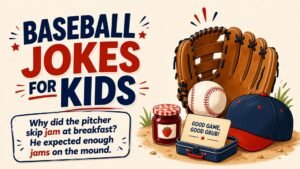
- Why did the pitcher skip jam at breakfast? He expected enough jams on the mound.
- The glove complained at practice: “Why does everybody keep throwing things at me?”
- What did the changeup say to the fastball? “Slow down—you’re making me look late.”
- Lunchbox note: Have a home-run kind of day—just don’t slide into class.
- Pitcher: “Special delivery!” Catcher: “Put it right in the mitt.”
- Catcher: “That pitch crossed me up.” Pitcher: “At least it crossed the plate.”
- Why do night games never need a flashlight? The stadium already brought the bright idea.
- Runner after a clean slide: “I stuck the landing… sideways.”
- Ground balls are the dirt’s way of asking for a scoop.
- Coach: “What’s today’s goal?” Team: “More hits than excuses.”
- Lunchbox note: Steal second if you must, but don’t steal anyone’s cookies.
- Why did the glove pose for a picture? It wanted proof of its best catch.
- Extra innings: when the snack bag officially becomes part of the roster.
- Pitcher: “The mound feels hot.” Catcher: “Try throwing something cooler than a heater.”
- Rough first inning? Good thing baseball doesn’t grade on first impressions.
- What did the catcher say after dropping strike three? “Well, that out just got complicated.”
- First base is where a single checks in before deciding whether to travel.
- Base coach: “Home!” Runner: “Finally, directions I understand.”
- What did the outfielder say after a diving catch? “Good thing the grass was there to catch me.”
- Catcher to wild pitch: “That was not our meeting spot.”
- What did the infielder say during the rundown? “Pick a base—we can do this all inning.”
- Rookie: “Which glove is mine?” Coach: “The new one that still smells better than the dugout.”
- Bat before first pitch: “Wake me when it’s my turn to make noise.”
- Tag is a playground game until cleats and bases get involved.
- Shortstop: “I’ve got it!” Second baseman: “Then why are we both under the same pop-up?”
- Pitcher: “How was that joke?” Catcher: “Better location than your last pitch.”
- Runner after scoring first: “Well, somebody had to break the tie.”
- Why did the catcher bring a tiny chair? His crouch wanted a day off.
- Fielder to bad hop: “Pick a lane!”
- Spring has one big advantage: baseball season gets its job back.
- Batter after five foul balls: “I’m getting my money’s worth from this at-bat.”
- Dugout call: “Who’s ready?” Team: “Who’s asking, and are we batting?”
- Where does a baseball joke sit during the game? In the dugout until it gets called up.
Baseball Knock-Knock Jokes for Kids
- Knock, knock.
Who’s there?
Batter.
Batter who?
The batter on deck—open up before I miss my turn. - Knock, knock.
Who’s there?
Pitch.
Pitch who?
Pitch in and help me carry the gear. - Knock, knock.
Who’s there?
Base.
Base who?
The base you skipped—turn around before the umpire notices. - Knock, knock.
Who’s there?
Call.
Call who?
Call me safe when I reach second. - Knock, knock.
Who’s there?
Pop.
Pop who?
The pop fly heading your way—heads up! - Knock, knock.
Who’s there?
Catch.
Catch who?
Catch me if you can—I’m stealing second! - Knock, knock.
Who’s there?
Slide.
Slide who?
Slide over—I need room on the bench. - Knock, knock.
Who’s there?
Deck.
Deck who?
Deck me out in team colors for game day. - Knock, knock.
Who’s there?
Fair.
Fair who?
Fair warning—that ball is headed your way! - Knock, knock.
Who’s there?
Rally.
Rally who?
Rally the dugout—we’re only down by one! - Knock, knock.
Who’s there?
Short.
Short who?
Short answer: we won! - Knock, knock.
Who’s there?
Double.
Double who?
Double up—we’ve got two games today! - Knock, knock.
Who’s there?
Coach.
Coach who?
Coach forgot the lineup card—open the door! - Knock, knock.
Who’s there?
Strike.
Strike who?
Strike up the cheers—the game is starting! - Knock, knock.
Who’s there?
Run.
Run who?
Run home—the winning run is coming!
Classroom, Lunchbox and Joke-of-the-Day Picks
- Baseball at the front of class: always trying to get ahead in the count.
- What did the pitcher bring to show-and-tell? An imaginary curveball—the teacher banned live pitches indoors.
- The glove earned a gold star for catching every assignment.
- Test-day note: Take a swing at every question.
- Runner after homework: “Done early—I wanted extra time at home.”
- Why did the pitcher like chemistry class? He was always mixing speeds.
- Lunchbox note: Swing at the quiz, not the lunch bell.
- A shortstop’s notebook has one rule: keep the notes brief.
- The base runner clipped his homework together—loose sheets kept sliding.
- Batter in fractions class: “Can I get a piece of the plate?”
- Recess advice: run hard, but save the base stealing for practice.
- Why did the catcher sit in the back row? He was used to seeing everything from behind.
- Hall-monitor umpire: “Safe hallway. Out of the running zone.”
- Ground balls make a surprisingly convincing gravity lesson.
- Art-class pitcher: “I only draw curves.”
- The dugout stayed quiet during the quiz—everyone was waiting for a sign.
- Why did the batter bring a metronome? He wanted his swing on beat.
- Why did the batter study flash cards between innings? He wanted fewer swings and misses on the quiz.
- Why did the class argue over catcher interference? Everyone suddenly became an expert on personal space.
- Runner with a calculator: “I’m checking how many feet until home.”
- Why did the coach highlight the lineup card? He wanted the starters to stand out.
- Why did the pitcher read mystery books? Every good ending had a twist.
- Why did the scorekeeper join the school play? He already knew how to track every scene.
- Graph-paper batter: tracking progress one square—and one swing—at a time.
- Why did the outfielder study clouds? He wanted extra practice looking up.
- Permission slip reason: Away game—the bus apparently counts as homework now.
- Coach wrote one phrase on the board: Cover the basics.
Funny Baseball Captions for Instagram and Game Day

Short Baseball Caption Puns
- Warning track behind me, wall closer than it looks.
- Section 112, glove in lap, eyes on the batter.
- Currently ninety feet from my next good decision.
- Cleats on. Small talk off.
- On-deck circle, camera briefly invited.
- Bat flip in the air, camera right on time.
- Batting gloves before camera filters.
- On deck and already overthinking the pitch.
- Line drive in the frame, reaction time not included.
- Foul-tip reflexes, photo-ready face.
- Catcher’s mitt up, mask on, camera safely behind the net.
- Mound view > office view.
- Baseline chalk on the cleats—proof I found the field.
- Nine innings, zero boring angles.
- Glove on the rail, game in the background.
- Sunset over the outfield, stadium lights taking the late shift.
- One swing from changing the caption.
- Sliding into the tag with absolutely no plan for elegance.
- Hometown noise, home-run view.
- Scoreboard math and seventh-inning snacks.
- Diamond in the background, dirt in the foreground.
- Seventh inning, same seat, louder voice.
- Ninth-inning nerves, first-row face.
- One-run lead, zero relaxed faces.
- Major-league pose, minor-league hair.
Player, Team and Fan Photo Captions
- Batting stance: locked in. Camera smile: still in spring training.
- Pitcher on the mound, everyone else suddenly an expert.
- Catcher gear: one player, approximately half the equipment bag.
- Uniform status: mostly dirt, technically still team colors.
- Dugout crew powered by sunflower seeds and unsolicited strategy.
- Bleacher selfie with the foul pole photobombing.
- Scoreboard proof that staying through the ninth was worth it.
- Rally cap on; dignity temporarily optioned to the minors.
- Walk-off win, walk-off photo, zero time for subtle celebrations.
- Postgame picture with the teammates who made tough outs look routine.
- Caught the swing, missed the ball, kept the photo.
- Mound visit: five people discussing one baseball.
- Behind the plate, where every pitch starts looking personal.
- Sliding photo: helmet crooked, tag close, timing perfect.
- Team picture before someone photobombs it with a batting helmet.
- Front-row energy from seats that definitely were not front row.
- Scoreboard says win; camera roll says storage warning.
- Rookie season, veteran-level posing.
- All-Star effort, eye black still undefeated.
- One line drive away from ruining a perfectly framed shot.
- Home plate in the background, home team filling the frame.
- Postgame handshake line, pre-caption debate.
- World Series dreams, Little League snack budget.
- Final out caught; now somebody catch the team before they leave.
- Final out in the book, last frame in the camera roll.
FAQs About Baseball Puns and Jokes
How do you write a baseball pun that sounds natural?
Start with a baseball term that has a real second meaning. Make the setup and payoff work in both senses; if removing the baseball word leaves a line that could describe any sport, the line is too generic.
Which baseball jokes are suitable for kids and Little League teams?
The easiest baseball jokes for kids use familiar actions, short setups, clear punchlines, and clean language. Jokes about batting, running bases, gloves, coaches, uniforms, and simple game situations usually work better than jokes that depend on obscure rules.
How do I choose a baseball caption for Instagram?
Match the line to something visible in the photo—the mound, catcher’s gear, scoreboard, dirty uniform, dugout, bleachers, rally cap, or walk-off celebration. Photo-specific baseball captions sound more natural than generic game-day phrases.
What is the difference between a baseball joke and a baseball riddle?
A baseball joke gives the punchline immediately after its setup. A baseball riddle hides a player, play, rule, or piece of equipment behind clues and gives the reader a moment to guess the answer.